What is Bipolar disorder ? What is mood disorder ? and how is it related to Mania and depression. These are some of the common doubts people have. So addressing that I will be writing a series of articles on Bipolar disorder.
This article will be the first in the series discussing Bipolar disorder.
Bipolar affective disorder, also known as Bipolar disorder or more simply a mood disorder. It is a mental health condition affecting a person’s mood.
It occurs in 0.3% to 0.5% of people in the Indian population.
So, what happens? If a person experiences occasional mood swings, does that mean that the person has Bipolar disorder?
NO
Bipolar disorder is characterized by persistent and significant change in mood along with certain other symptoms which leads to the disruption of a person’s day to day activities.
Let us explore that in a bit more detail.
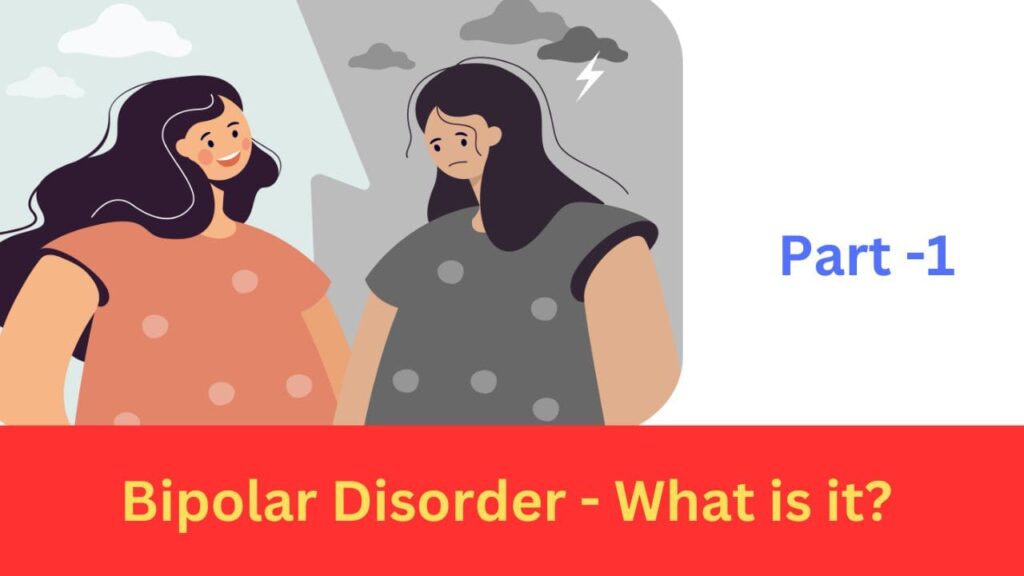
There are basically 2 major states- Mania & Depression.
In the state of Mania people experience-
A person may feel excessively excited, cheerful or angry. People can become increasingly energetic, overly confident, and may take unnecessary risks. They may be excessively religious, spend money inappropriately, increased sexual drive and may lack social inhibitions. Because of increased energy the person may sleep less, experience increased speed in thoughts, talk excessively, may appear to be always on the move, the person may say or do things that are inappropriate and out of character.
In the state of Depression–
A person feels down, upset or tearful, tired or sluggish. The person may not find pleasure or joy in things which they previously used to enjoy. A depressed person may have low self-esteem and lack of confidence, feelings of guilt, worthlessness or hopelessness. He or she may have trouble sleeping or may sleep too much, Have poor appetite, may become withdrawn from people and inactive. A depressed person may have thoughts of suicide.
Because the condition involves two mood states, the illness is called Bipolar, the term ‘affective’ refers to being associated with emotion/mood. Hence the name Bipolar Affective Disorder.
The other mood states-
Apart from the two major states that i mentioned above, there are a few other states in between, mainly
Hypomania– The symptoms are similar to mania, but are fewer in number and less severe.
Based on severity and number of symptoms depression can be classified as- Mild, Moderate and Severe depression.
Mixed states– It is a condition in which symptoms of both mania and depression are present.
Mood state associated with psychotic symptoms- An episode of mania or Moderate, Severe Depression may be associated with additional symptoms known as psychotic symptoms.
Psychotic symptoms mainly include different kinds of hallucination and delusions- a wrong, unshakeable belief which is held with extraordinary conviction. Psychotic symptoms need not be present with all instances of a mood disorder.
Bipolar 1 vs Bipolar 2
Based on the pattern of how mood symptoms present, the doctors may specify it as either Bipolar 1 or 2.
In Bipolar 1: A person has had at least 1 episode of Mania. This person may or may not have depression.
In Bipolar 2: A person has at least 1 episode of depression and 1 episode of hypomania.
Cyclothymia
A person may be diagnosed with cyclothymia if they have had symptoms of depression and mood elevation but not severe enough to warrant a diagnosis of Bipolar disorder.
So, how is the condition diagnosed and treated ?. What is the prognosis?
I’ll be covering that in the subsequent articles.
References
Thumbnail Image by Designed by Freepik at Freepik.com